
Housing Command Centers
The solution to homelessness seems simple: match people in need of support and shelter with services and available housing units. However, simple does not mean easy, and HCC implementation requires committed leadership and both initial funding for structural and systemic changes as well as sustained funding to maintain the new system. In terms of leadership, communities must identify the center of gravity for decision-making to drive a different type of response and organize resources differently to address homelessness. This center of gravity could be the mayor, the city manager, the business community, an outspoken advocate, a faith leader, or really anyone who has strong influence and reach in their community and the power to enact change in the response system. Prior to implementation, successful communities must also have homeless assistance providers with enough capacity to provide case management and re-housing, given that an HCC relies on outreach workers. It is also critical that there be a centralized team responsible for acquiring units under the HCC, rather than having this function distributed across multiple entities, as pairing housing options with outreach is critical to expediting the re-housing process.
Communities have used various funding methods for HCC responses to homelessness. Houston’s model relied on federal funding for specific challenges or disasters and leverages Housing Choice Vouchers. Recent examples have been able to rely less on federal funding. Cleveland primarily uses general operating budget funds combined with emergency vouchers allocated through the American Rescue Plan Act that needed to be used, while Denver funds its program through a retail sales tax increase specifically designated for funding homelessness services and housing. In both Cleveland and Denver, the average annual cost to house an individual and provide necessary supportive services ranges from $24,000 to $30,000.
Housing Command Centers represent a fundamental shift in how communities respond to homelessness by treating it as an urgent crisis and implementing a unified approach to accelerating housing placement. By leveraging its authority to establish shared goals and coordinate efforts among service providers and landlords, a city can lead a more streamlined, efficient re-housing process and connect unhoused people with individualized services they need. Modeling the urgency displayed in responding to natural disasters, HCC teams rapidly assess needs, match individuals to available housing and services, and remove barriers to placement, drastically reducing the time required to house individuals. By prioritizing collaboration, flexibility, and speed, HCCs ensure that people experiencing homelessness receive timely support. While specific funding sources and intervention points may vary by locality, the core principle remains the same: homelessness is an emergency and warrants the same level of urgency as any other disaster.
Irma, and Maria in 2017. The magnitude of these disasters created a need to rethink the local emergency housing response, with FEMA supporting the development and implementation of a new approach. When flooding struck Baton Rouge in 2016, there happened to be one person serving as the Executive Director of the Housing Authority, embedded within the Housing Finance Agency, and overseeing the Emergency Solutions Grant (ESG) program. This individual was therefore able to take more of a systems level approach to combine and streamline funding to better and more quickly meet housing needs. The overlap in roles enabled the state to respond to the floods using HOME Tenant Based Rental Assistance, ESG, and Housing Choice Vouchers so that people in disaster shelters could exit to permanent housing.
This streamlined approach to natural disaster response informed Houston’s recovery from Hurricane Harvey the following year, leveraging Category B of FEMA’s Public Assistance Program to implement a Command Center for housing. The Command Center adapted the latter hierarchy of emergency response to homelessness policy and interventions, enabling quick decision-making to house and serve people in need. Houston’s first Special Assistant to the Mayor for Homeless Initiatives, appointed in 2013, brought targeted focus to this issue and successfully led design and implementation of the HCC response. As of 2022, Houston was able to reduce the wait time for housing to 32 days, a remarkable reduction from the average of 720 days in 2012.
Today, Houston is widely regarded as a national leader in implementing a coordinated response to homelessness. The city’s first targeted response began prior to the hurricanes, with participation in the Mayors Challenge to End Veteran Homelessness in 2012. This challenge created the impetus and federal resources for then-Mayor Annise Parker to convene all relevant parties and figure out how to match HUD-VASH vouchers with veterans experiencing homelessness, resulting in “functional-zero” for veteran homelessness. The city then moved to partner with Harris County to combine the mental health services of the county and the housing funding services of the city to tackle broader homelessness using the same streamlined model. Since 2012, according to the Coalition for the Homeless of Houston / Harris County, over 33,000 people have been housed with a 90% success rate for local housing programs. This collaboration went a step further in the aftermath of the hurricanes in 2017, when Houston Mayor Sylvester Turner declared that no one would leave the disaster shelters homeless. This disaster brought additional federal resources, allowing Houston to treat broader homelessness with the urgency of an emergency response.
The COVID-19 pandemic further crystallized and expanded this “unified command group” response, especially given that providing non-congregate shelter options at this time became essential. Los Angeles launched Project Roomkey to provide hotel and motel rooms to individuals experiencing homelessness who were particularly vulnerable to COVID-19, and the State of California launched the Homekey program to provide funds to acquire and/or develop hotels and motels for conversion into permanent supportive housing. Through collaboration between the federal, state, and county governments as well as the Los Angeles Homeless Services Authority (LAHSA), 4,000 units in 37 hotels and motels were secured for temporary housing. The expedient response catalyzed by the COVID-19 emergency made leaders start to work through how this type of re-housing process could be extrapolated and sustained. On her first day in office in 2022, Mayor Karen Bass declared a State of Emergency on homelessness and launched Inside Safe, which has brought over 4,000 people inside and over 900 of them into permanent housing through a Command Center approach.
The following case studies examine two cities, Denver and Cleveland, that have achieved great success with the Housing Command Center approach, using it to accelerate the housing process at different intervention points. In Cleveland, a right-to-shelter city, the A Home for Every Neighbor initiative focuses on the chronically homeless unsheltered population and works to provide options that allow them to remain stably housed. In Denver, the HCC component of the All In Mile High initiative identified a need for more non-congregate shelter beds to effectively re-house people living in large encampments. Figure 2 below depicts the typical process from Coordinated Entry to a permanent housing solution. Denver condenses the steps between temporary shelter and a permanent housing option through their HCC. Cleveland similarly condenses this process but starts with street outreach. In both cities, the HCCs help speed up the outlined pathway to housing, that may have alternatively been determined through Coordinated Entry, by guiding individuals through the process while prioritizing getting housing or shelter as quickly as possible. HCCs expedite the re-housing process, visibly and tangibly reducing the number of people sleeping outside and supporting these individuals in getting stabilized.
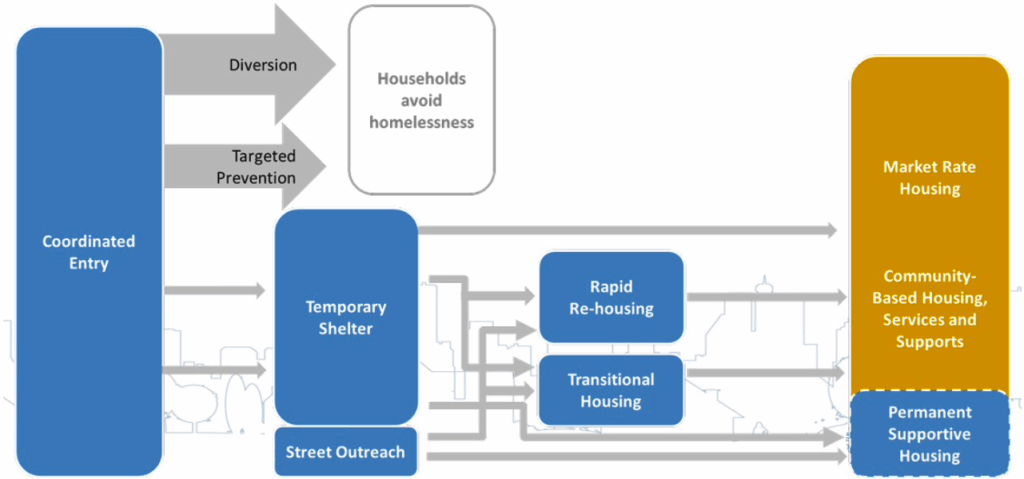
Source: HUD Training on “Notice Establishing Additional Requirements for Coordinated Entry” (March 2017).