

Housing White Papers
- Task Force Publications
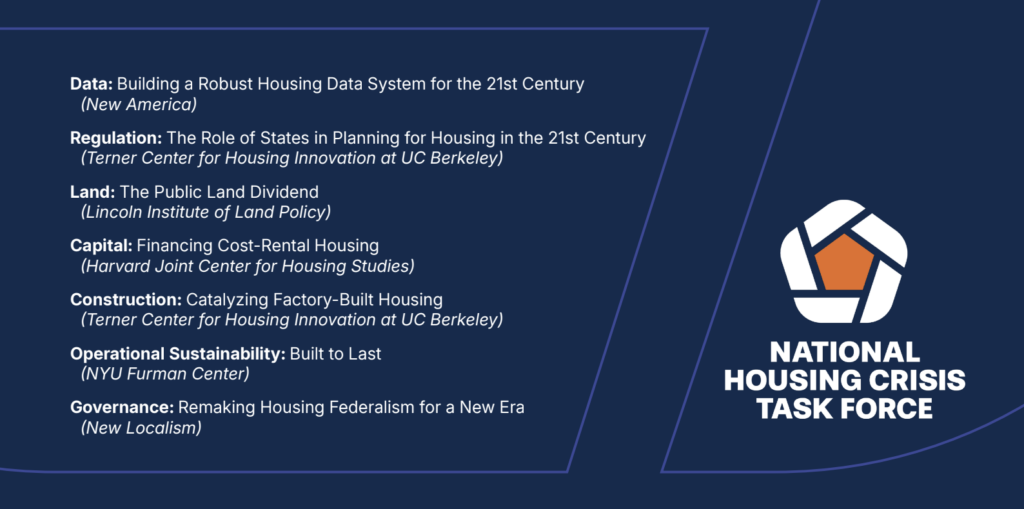
The National Housing Crisis Task Force has released seven white papers from leading research institutions, spanning the building blocks of America’s housing system: data, regulation, land, capital, construction, operational sustainability, and governance. The collection will inform the Task Force’s National Housing Agenda, to be published in February 2027.
The seven papers are:
- Building a Robust Housing Data System for the 21st Century (New America) proposes a National Housing Data Authority with three core functions: a national data exchange, a data action lab, and a state and local data hub.
- The Role of States in 21st Century Planning (Terner Center for Housing Innovation at UC Berkeley) examines how California, Florida, Maryland, New Jersey, and Oregon use their authority to plan and zone for more housing.
- The Public Land Dividend (Lincoln Institute of Land Policy) argues that state and local governments should manage surplus land as a portfolio for lasting affordability, not sell it off parcel by parcel.
- Financing Cost-Rental Housing (Harvard Joint Center for Housing Studies) proposes a federally insured, state-allocated debt product to support rents set at the cost of operating the building, and simulates its performance across 18 major cities.
- Catalyzing Factory-Built Housing (Terner Center for Housing Innovation at UC Berkeley) tests policy frameworks for scaling factory-built housing in California, Colorado, Virginia, and Michigan.
- Built to Last (NYU Furman Center) lays out how to keep the nation’s aging housing stock affordable, financially sustainable, and habitable over the long term.
- Remaking Housing Federalism for a New Era (New Localism Associates) examines how the roles of federal, state, and local governments are shifting and how to take the best local innovations to scale.
—
These papers were produced in partnership with the National Housing Crisis Task Force. While the Task Force supported this collection, it does not formally endorse its findings; the views expressed are those of the authors. Task Force members and co-chairs, who participate in their individual capacities rather than on behalf of their organizations, bring a range of professional and lived experience to their work and may not agree with every statement in every paper, but remain committed to working together on solutions to the housing crisis.